Turn business context into governed, evidence-backed action
Connect operational data, organizational context, policy, authority, human decisions, controlled execution, evidence, exceptions, analytics, and governed AI across entities, jurisdictions, and functions.
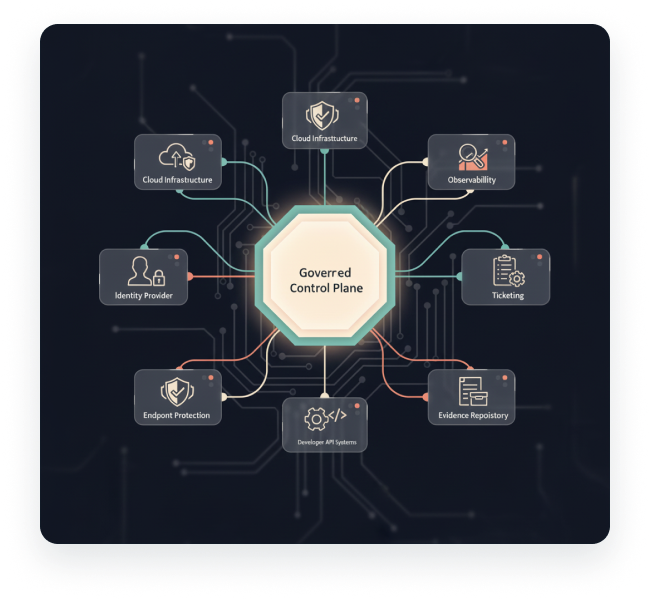
What is Governed Business Operations Intelligence?
Governed Business Operations Intelligence is a software category that connects operational data and organizational context with policies, authority, human review, controlled execution, evidence, exceptions, analytics, and governed AI. It helps complex organizations understand what is happening, determine what is permitted, authorize the right action, preserve the evidence, and improve controls over time.
Business context
Objects, events, entities, jurisdictions, contracts, obligations, people, and systems in one operating context.
Governance
Policies, authority, approvals, segregation, limits, and exceptions evaluated at the point of action.
Authorized action
A qualified human decision, then execution through permitted users or bounded service identities.
Evidence
Sources, reasons, approvals, before and after values, timestamps, and outcomes preserved with the action.
Continuous intelligence
Understanding that informs the next action — before, during, and after execution.
Governed Business Operations Intelligence
Business systems record work. Governance often lives somewhere else.
Organizations may have transactional systems, spreadsheets, policy libraries, approval tools, document repositories, analytics, and AI assistants. The challenge is that operational context, authority, evidence, and intelligence often separate at the point where a material decision must be made.
The record without the situation
Systems may know a transaction but not the complete entity, jurisdiction, obligation, contract, policy, or ownership context.
Documented but not applied
Policies and approval limits may be documented but not evaluated inside the action.
Doing is not authorizing
The person performing work may not be the person authorized to approve it.
Assembled afterwards
The reason, source, approval, and resulting record may be scattered across tools.
Describes the past without governing the next action
Dashboards may describe outcomes after the fact without helping teams govern what happens next.
The category exists to connect those layers before, during, and after execution.
See the defining propertiesWhat it is — and what it is not
Eight dimensions, five adjacent categories, one neutral comparison. Individual products in every column vary widely; nothing here asserts superiority over a named product.
| Dimension | ERP | Business Intelligence | GRC | Workflow Automation | AI Copilot | ZOIKO |
|---|---|---|---|---|---|---|
| Primary organizing principle | Transactions, master data, functional processes | Data models, reports, visualizations | Risk, controls, policies, assessments | Tasks, steps, routing rules | Prompts, content, analysis | Contextual, policy-aware, authorized, evidence-backed operations |
| Point of intervention | At the transaction | After the event | Around the process | Between steps | At the user's request | At the material decision |
| Governance placement | Configured around the module | Generally outside scope | Managed as a separate discipline | Encoded in routing depth that varies | Varies by deployment | Evaluated inside the action, before execution |
| Evidence model | Transaction records and system logs | Query results and snapshots | Control test records and assessments | Task history | Chat or output history | Manifests linking sources, policies, decisions, execution, and outcomes |
| Cross-functional context | Often module-bounded | Depends on the data model | Control-domain bounded | Process bounded | Session bounded | Shared objects, events, entities, and authority across functions |
| Jurisdiction context | Localization packs and country versions | A reporting dimension | A compliance register | Usually configured per workflow | Not inherent | Resolved per action with published coverage status and source |
| Intelligence timing | Operational reporting | Commonly retrospective | Periodic assessment | Process metrics | On demand | Before, during, and after execution |
| AI boundary | Varies by product | Varies by product | Varies by product | Varies by product | Authority and evidence boundaries vary | Source-grounded, permission-aware, uncertainty-disclosing, human-reviewed |
What makes the category coherent — and testable
Select a property to see the product proof that supports it. All six descriptions stay on the page.
Context-connected
Business objects, events, entities, jurisdictions, contracts, obligations, people, systems, policies, and evidence are related in one operating context.
Governance-active
Policies, authority, approvals, segregation of duties, limits, and exceptions are evaluated at the point of action.
Human-accountable
Material decisions preserve responsible humans, authorized roles, service identities, reasons, and review paths.
Evidence-native
Sources, policy reasons, approvals, before and after values, timestamps, and outcomes become part of the operational record.
Intelligence-continuous
The platform supports understanding and control before, during, and after execution — not only retrospective reporting.
AI-governed
AI uses authorized sources, discloses uncertainty and gaps, respects permission and policy boundaries, and remains subject to human review.
Context-connected
The operations graph relates one vendor bank-detail change to its vendor master record, contract, entity, jurisdiction, payment policy, delegated authority, requester, approver, verification evidence, integration event, prior exceptions, and due date — before any rule is evaluated.
See the business context around every material action
Sixteen node types relate operational records, governance, people, systems, and evidence. The graph is a view — the relationship table below carries the same information.
Intelligence matters when it changes how the next action is governed
Four control zones summarize the nine-stage governed-action lifecycle. Select a zone to see which stages it covers.
Understand
Capture the signal; establish business, entity, jurisdiction, policy, obligation, and evidence context.
Determine
Evaluate policy, authority, segregation, limits, conflicts, missing information, and required reviewers.
Authorize & execute
Build the proposed action; route responsibility; obtain qualified human authorization; execute through controlled service identities.
Evidence & improve
Create evidence; monitor obligations and outcomes; route exceptions; measure control performance.
A cross-border vendor payment change begins as an integration event and a contract amendment. The platform links both sources by correlation ID, resolves the entity and jurisdiction, and attaches the evidence requirements before any rule is evaluated.
Zone 01 focuses entirely on grounding signals into context. No action is authorized here; all data ingestion, entity mapping, and policy checks occur purely to build the verifiable operating foundation.
Ingestion and signal parsing are performed by secure system connectors operating under strict read-only integration identities.
Governance is evaluated inside the action
Seven control domains operate as active logic, not as a policy library sitting beside the work.

Make jurisdiction context visible at the point of work
Coverage status, source authority, ruleset version, and last review date travel with every jurisdiction claim. Unverified coverage never appears as active.

Create the evidence while the work happens
Evidence is an operational output of the action, not an export produced later. Eight health dimensions describe whether it can actually be relied on.
EVIDENCE HEALTH DIMENSIONS
Understand what needs attention before it becomes a control failure
Four horizons. Only the first is what most dashboards deliver — the category requires all four.
What happened?
Actions, events, changes, obligations, approvals, evidence, and outcomes.
Why did it happen?
Policy outcomes, authority paths, missing evidence, integration failures, exception causes, and control gaps.
What needs attention next?
Upcoming obligations, expiring authority, overdue reviews, evidence gaps, coverage changes, and pending decisions.
What action may be appropriate?
Source-grounded options subject to policy, permission, authority, evidence, and human review.
Every metric is defined, scoped, sourced, and time-bounded. None of them measure individuals. There is no productivity score, no behavior-policing metric, and no hidden monitoring anywhere in the model.
AI can support the work without becoming the authority
AI is one governed capability inside the category — never the category itself.

Cross-functional because functions share one model — not because the list is long
Select a function to see which shared core objects it uses. The core does not change; the workflow does.
Twelve objects every function uses
A finance approval and a payroll release resolve the same entity model, the same authority model, and the same evidence model. That is what makes the coverage cross-functional rather than merely broad.
Finance
Accounting; general ledger; AP; AR; treasury; reconciliation; close; consolidation; revenue integrity.
Workforce
Human resources; payroll; compensation; benefits; leave; workforce compliance; employment contracts; offboarding.
Legal & Commercial
Contracts; clauses; obligations; board resolutions; corporate actions; procurement; vendor management; spend controls.
Tax & Compliance
Tax determination; VAT/GST; withholding; filing management; obligations; regulatory reporting; exceptions.
Governance & AI
Policies; jurisdiction intelligence; approvals; delegated authority; segregation; evidence; governed AI; analytics.
Platform Foundation
Multi-entity; multi-jurisdiction; data residency; APIs; integrations; developer platform; migration; events.
Keep global policy and local reality visible at the same time
A global baseline that cannot accommodate a local exception is not a policy — it is a wish. The inheritance model makes both visible.

The category does not change by role. The proof you need does.
Five primary decision makers, seven secondary stakeholders, one category definition.
Govern approvals, treasury, and close across entities
Govern approvals, treasury, revenue, close, controls, multi-entity operations, and evidence.
Authority and evidence across a multi-entity close
Proof to review: the policy decision record and the scope matrix.
Diligence resource: Evidence Architecture brief.
Controllers · Tax Leaders · Compliance Leaders · Audit Committees · Boards · Procurement · Regulators — each routed through the same category model with role-appropriate visibility and read-only evidence packages where relevant.
Role selection changes examples and recommended links only. No personalization is inferred without consent.
Intelligence Command Center
Attention, context, governance, evidence, and next action in one role-aware surface.

Governed Action Review
Where context, policy, authority, evidence, and human authorization become one decision experience — with the decision controls reflecting real permission.

Policy Decision Record
Input facts, machine evaluation, human outcome, exception, and audit metadata — kept separate so a reviewer can see exactly where the machine ended and the person began.

Evidence Manifest and Decision Timeline
The complete evidence object around one material action, and the review path that produced it.

Intelligence and Control Analytics
Every metric carries a definition, formula, scope, source, refresh, owner, exclusions, and limitations. Metrics that cannot state those things do not appear.

Eight layers, one attributable context
The category depends on context surviving every system boundary. These layers exist to make that true.
EXPERIENCE
Role-aware workspaces, queues, review surfaces, and analytics.
BUSINESS MODULES
Finance, workforce, legal, tax, compliance, and procurement execution.
OPERATIONS GRAPH
Shared objects, events, entities, jurisdictions, people, systems, and relationships.
GOVERNANCE CONTROL PLANE
Policy, authority, segregation, approvals, obligations, and exceptions.
EVIDENCE
Manifests, integrity, retention, legal hold, and controlled export.
INTELLIGENCE AND AI
Metrics, horizons, governed AI with authorized sources and human review.
APIS AND EVENTS
Typed events, scopes, service identities, idempotency, replay, and reconciliation.
DATA AND DEPLOYMENT
Residency, tenancy, encryption, keys, lineage, observability, and recovery.

Qualified options, visible limits
Unavailable options stay visible with a reason. No option is recommended without requirements you provide.
Regional hosting
Processing and storage in a selected region.
Dedicated private cloud
Isolated tenancy with enhanced operational controls.
Enterprise single-tenant
Dedicated workload and data infrastructure.
Sovereign deployment
Region-restricted operations, administration, and support.
On-premise deployment
Customer-operated infrastructure within their own boundary.
Customer-controlled keys
Platform-managed, BYOK, HYOK, or customer-controlled keys.
| CONTROL | REGIONAL HOSTING | DEDICATED PRIVATE CLOUD | ENTERPRISE SINGLE-TENANT | SOVEREIGN / ON-PREMISE |
|---|---|---|---|---|
| Tenancy | Multi-tenant, logical isolation | Dedicated tenancy | Dedicated workload and data | Fully isolated |
| Data residency | Selected region | Selected region | Selected region or restricted set | Customer-defined boundary |
| Key management | Platform-managed | Platform-managed or BYOK | BYOK or HYOK | Customer-controlledVerified per deployment |
| Network boundary | Standard controls | Private connectivity options | Private connectivity | Customer network |
| Identity | Federated SSO · SCIM | Federated SSO · SCIM | Federated + dedicated directory | Customer directory |
| Administrative access | Platform operations | Platform operations, scoped | Scoped with customer approval | Customer-administered |
| Backup & recovery | In-region | In-region | In-region or cross-regionWhere approved | Customer-operated |
| Support model | Standard | Enhanced | Enhanced, named contacts | Defined per agreement |
| Update model | Continuous | Continuous, scheduled windows | Scheduled | Customer-scheduled |
| Integration model | Full catalogue | Full catalogue | Subject to network design | Requires architecture review |
| Market availability | AVAILABLE | AVAILABLE | CONFIGURATION REQUIRED | MARKET DEPENDENT |
Purpose limitation and least privilege
Access follows purpose, not curiosity. Workforce data stays inside workforce purposes; commercial data stays inside commercial purposes; role-specific visibility is enforced rather than advised.
Minimized analytics, authorized AI sources
Analytics are aggregated and defined. AI reads only authorized sources within the requesting user's permission and data-classification scope. Retention is configurable per class.
Prove the operating model before production activation
Five phases. Shadow Mode runs the category's full evaluation and stops before execution.
Discover
Map systems, entities, jurisdictions, functions, objects, owners, policies, authority, evidence, integrations, and gaps.
Model
Configure the operations graph, governance controls, evidence requirements, roles, workflows, events, and boundaries.
Shadow Mode
Compare proposed context, policy outcomes, approval routes, evidence, and exceptions — without executing production actions.
Controlled activation
Activate selected functions, entities, jurisdictions, workflows, and integrations with approval and rollback criteria.
Expand and assure
Add scope; monitor control effectiveness, evidence quality, adoption, exceptions, and architecture health.

Diligence routes, every claim qualified
Status terms distinguish verified, aligned, designed, in review, and unavailable. Certification marks stay absent until independently verified and approved.
- Zero-Trust
- Identity and access
- Encryption and keys
- Application / API security
- Vulnerability management
- Secure development
- Incident response
- Business continuity
- Compliance overview
- SOC 2 readiness
- ISO 27001 alignment
- GDPR / CCPA controls
- Data Processing Agreement PDF · new tab
- Subprocessors
- Retention
- Responsible AI
- Accessibility
- Evidence architecture
- Audit trails
- Policy decision logging
- Manifests
- Document integrity
- Internal controls
- Segregation
- Reporting
- Residency
- Regional hosting
- Private / single-tenant
- Sovereign / on-premise
- BYOK / HYOK / customer keys
- Recovery
- Architecture Library
- Integration guide
- Migration guide
- Documentation
- Support
- System status
- Release notes
- Training
No legal, tax, accounting, audit, investment, employment, or other regulated professional advice. Qualified professionals remain responsible for final review and regulated use.
Build the business case from your baseline — not from our percentages
Five value dimensions, each with a baseline question and the indicators you would measure. No invented savings, ROI figures, or benchmarks appear anywhere on this page.
Decision quality
“Are material actions evaluated with complete context, policy, authority, and evidence?”
Rework · escalation rate · missing information at decision · exception cause mix
Control effectiveness
“Are policies, approvals, segregation, and exceptions operating as designed?”
Block and override rates · authority gaps · overdue reviews · compensating controls in force
Evidence readiness
“Can teams retrieve attributable evidence without reconstruction?”
Manifest completeness · retrieval time · missing sources · export readiness
Operational speed
“Can approved actions move faster without bypassing controls?”
Cycle time · queue aging · approval latency · integration failures
Architecture simplification
“Can selected workflows, policy layers, reporting, or evidence processes be consolidated?”
Systems and hand-offs · duplicate data · manual reconciliation · integration maintenance
A value hypothesis, not a guarantee
The assessment produces a customer-specific hypothesis and a measurement plan you can test. It does not produce a guaranteed ROI claim.
No financial result is shown without your inputs and transparent assumptions.
See what governed business operations intelligence could look like in your organization
Explore how ZoikoSuite can connect operational context, governance, authority, evidence, intelligence, and governed AI across your entities, jurisdictions, functions, and systems.

Category, differentiation, and boundaries
Direct first sentences, then qualified detail. Every answer is present in the page source.
It is a software category connecting operational context, governance, authority, human review, controlled execution, evidence, exceptions, analytics, and governed AI.
The category formula is business context plus governance plus authorized action plus evidence plus continuous intelligence. A product missing any one of those parts belongs to a different category.See the definition