Govern complex operations with industry context built in
ZoikoSuite brings finance, workforce, legal, tax, compliance, evidence and governed intelligence under one control model across entities and jurisdictions — while your specialist industry systems keep doing their core jobs.

Route by sector, or by the problem
Two modes, no faceted filter maze. Browse industries is the default; start from a challenge suits problem-led buyers who do not identify with a single sector label.
Financial Service
Banking
Insurance
Healthcare
Telecom & MVNOs
Manufacturing
Energy & Utilities
Retail & Commerce
Government & Public Sector
Not listed here
The governance model stays consistent. The operating context does not.
A bank, hospital system, manufacturer, utility, retailer, telecom operator, insurer, financial-services group and public-sector organization do not execute the same workflows. The common control model resolves the entity, jurisdiction, authority, obligation, evidence and system context that applies to each action.
Different obligations
Regulators, filings, licenses, policies, contracts and control frameworks vary by sector and jurisdiction.
Different core systems
The governance layer must coexist with the transaction, clinical, network, industrial, commerce or public-sector systems already in place.
Different authority models
Signatory limits, segregation of duties, delegated authority, reviewer roles and escalation paths vary by operating model.
Different evidence expectations
The proof required for audit, legal review, regulator inquiry, board oversight or customer assurance is context-dependent.
Seven layers, identical in every sector
These are the layers each industry page proves in its own context. The mechanism does not change.
Entity context
Know which legal entity, business unit, fund, site, branch, facility or operating unit owns the action.
Jurisdiction context
Resolve country, state or province, regulator, filing authority, labor, tax, privacy or residency context at runtime.
Authority & policy
Evaluate role, delegation, segregation of duties, signatory authority, approval rule and policy before material execution.
Obligations
Know what is due, why it is due, who owns it, and what evidence exists.
Evidence
Preserve decision basis, workflow, documents, events and evidence manifests.
Integrations
Keep source truth in the appropriate system and propagate governed events through explicit contracts.
Governed intelligence
Assist with anomaly detection, forecasting, extraction, prioritization and decision support within human and policy boundaries.
Nine sectors, each with its category boundary
Every card states what ZoikoSuite is not in that sector. Two destinations are not yet production-ready and are shown without a link rather than as a dead card.
Financial Service
Regulated financial operations across entities, jurisdictions, obligations and evidence.
Banking
Govern approvals, obligations, vendors, evidence and enterprise operations around banking environments.
Insurance
Govern carrier operations, delegated authority, obligations, vendors and evidence around specialist insurance systems.
Healthcare
Govern administrative, workforce, vendor, financial, contractual and compliance operations in healthcare organizations.
No link is shown until the destination is production-ready
Telecommunication & MVNOs
Govern multi-market operator business operations, partner obligations, evidence and authority.
No link is shown until the destination is production-ready
Manufacturing
Govern enterprise operations across plants, suppliers, contracts, workforce, obligations and evidence.
Energy & Utilities
Govern business operations around critical energy and utility environments with clear OT/IT boundaries.
Retail & Commerce
Govern entities, stores, channels, suppliers, workforce, approvals, evidence and commercial obligations.
Government & Public Sector
Govern administrative operations across agencies, entities, programs, funds, procurement, workforce and records.
Route by the accountability you hold
The same governed action looks different depending on who is answerable for it. Only published destinations are linked.
Published solution page
Financial truth, close, governed approvals, entity and currency scope, evidence.
Published solution page
Obligations, two-layer authority, jurisdiction review, evidence classification.
Published solution page
Decision packets, oversight mode, multi-entity rollup, obligations register.
No role hub published · architecture destinations linked
Source ownership, data location, APIs, events, integrations, evidence architecture.
No role hub published · governance destinations linked
Control outcomes, evidence states, exception registers, oversight boundaries.
No role destination published
Workforce and payroll governance material has no published destination yet.
Coverage is stated per workflow, never as a blanket claim
Five coverage states are published at workflow level. A sector page never inherits coverage from this hub, and this hub never asserts coverage on a sector's behalf.
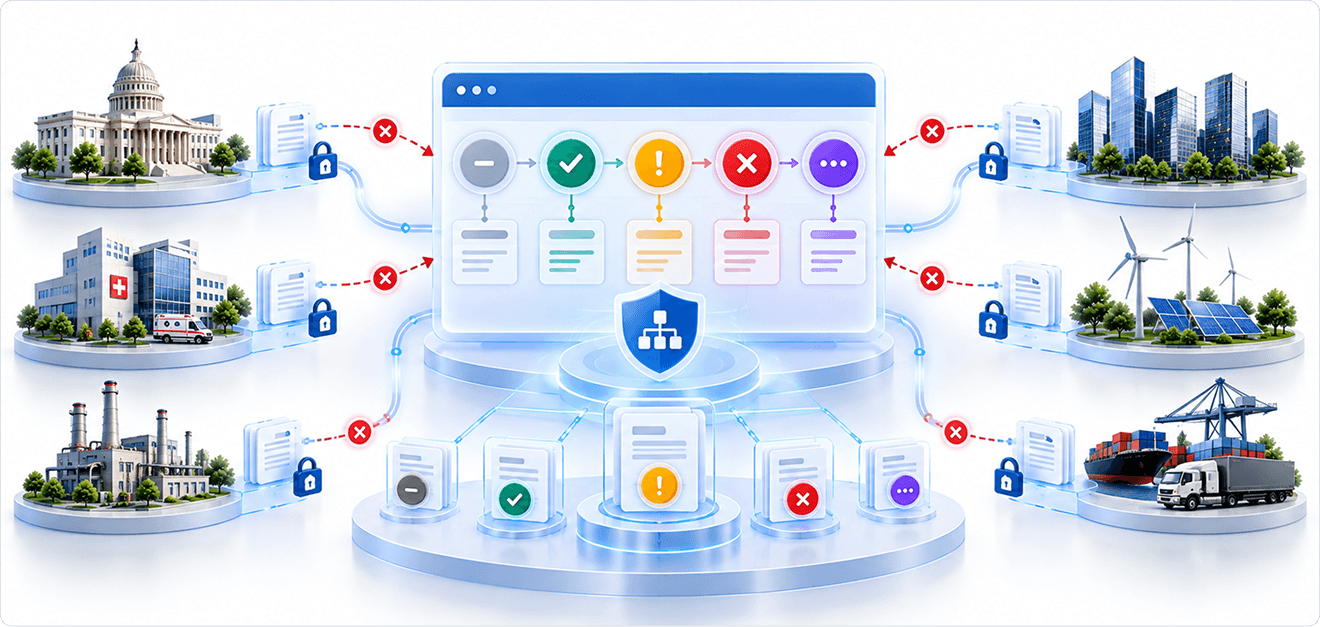
One evidence architecture, every sector
Six layers, identical across all nine industries. What differs is who asks for it and why.
Governance decision
Actor, entity, jurisdiction, policy basis, authorization outcome, timestamp.
Workflow history
Every transition, approver, delegation, rejection, escalation and rationale.
Document lineage
Version, integrity hash, access history, signature status, retention.
Operational event
Typed event, source service, object, actor or principal, correlation.
Evidence manifest
Scenario-specific package with controlled export and access record.
Integrity controls
Append-only records and tamper-evident chains, with cryptographic validation where implemented.
Complement to core systems, in every sector
The pattern is identical across industries: specialist systems stay authoritative for their own domain, and ZoikoSuite is authoritative for exactly one object.

One boundary, applied in every sector
Each industry page adds its own prohibitions on top of these. None of them relaxes what follows.
AI MAY - IN EVERY SECTOR
- Detect anomalies against configured expectations
- Forecast exposure from source data, labelled as a projection
- Extract obligations, clauses and metadata with provenance
- Prioritize exceptions for human review
- Summarize a decision basis with its sources cited
- Provide decision support to a named reviewer
AI MAY NOT - IN EVERY SECTOR
- Make any autonomous material decision
- Bypass authority, approval or segregation requirements
- Alter source truth in any system of record
- Satisfy an evidence requirement on its own
- Act on a customer, patient, claimant or constituent
- Substitute for professional or regulated judgment
If none of the nine fits, that is a real answer
Conglomerates span several sectors at once, and many organizations sit outside the current nine entirely. Neither is a poor fit for a governance layer — but neither is served by pretending a sector page covers them.
A group operating across two or more of the nine sectors carries different obligations and authority models per entity. The organization-pattern view handles that better than any single industry page.
The governance model is not sector-specific. If your sector is not among the nine, the operating challenge is usually the better entry point than the industry label.
An unlisted sector is not implicitly covered. No capability, obligation coverage or regulatory applicability transfers from a published industry page to a sector that has none.
Enterprise diligence routes
Architecture and product proof in place of logo walls and outcome percentages.
- Platform overview
- Governance Platform
- Core modules
- Platform Foundation
- Deployment options
- Migration & Shadow Mode
- Solution Brief
- Executive Resources
- Platform Tour
- Solve Critical Challenges
- Modernize Operations
- Expansion
Not published
No approved customer story, logo, reference or outcome figure exists for any sector. None is substituted with an anonymised composite.
No certification, attestation or blanket compliance is claimed for any regime. No specialist transaction, clinical, network, industrial-control, commerce or government service-delivery system is replaced.
Come with the sector, or come with the problem
If your sector is one of the seven published, start there. If you span several, or none of them fits, the operating challenge is the better entry point — and a conversation about which specialist systems must stay authoritative is more useful than a sector label either way.
No certification, blanket compliance, jurisdiction coverage, capability availability or customer outcome is committed outside an approved commercial document.
Book enterprise demo
Every section of this page was readable without it.
Coverage, coexistence, compliance and fit
Direct first sentences, then qualified detail. Every answer is present in the page source.
It applies one governed operating model — entity, jurisdiction, authority, policy, obligations, evidence, integrations and governed intelligence — across sector-specific business contexts.
The governance model stays consistent; the operating context does not. Your specialist industry systems keep doing their core jobs.