Govern financial operations before risk becomes evidence you have to reconstruct
ZoikoSuite connects finance, tax, compliance, evidence and cross-functional operations across entities and jurisdictions, so material actions can execute with policy, authority and auditability built in.

What does ZoikoSuite do for financial services?
ZoikoSuite governs financial operations: it evaluates material financial and operational actions against policy and delegated authority before they complete, preserves the decision basis and execution lineage as evidence, and holds entity, jurisdiction and effective-date context at the point of action. It coordinates across finance, tax, compliance and adjacent functions while authoritative records remain in the systems that already hold them.
Financial operations behave like one system. Fragmented software does not.
Five symptoms, each paired with the exposure it creates for an executive. No percentages, benchmarks or ROI figures — those would be invented.
Fragmented systems
Finance, payroll, HR, contracts and compliance maintain separate versions of truth.
Delayed decisions and reconciliation overhead.
Jurisdictional blind spots
Rules change by entity, transaction, country, state or province, filing authority and effective date.
Tax and regulatory exposure.
Governance after execution
Approvals, policy checks and legal review happen outside the action path.
Control failures discovered too late.
Evidence assembled manually
Records, approvals, rules and documents are reconstructed during audit.
Slow, expensive, fragile assurance.
Integration sprawl
Point-to-point dependencies multiply and ownership becomes unclear.
Security surface, vendor risk and technical debt.
Six control principles
The category definition, read through a financial-services lens.
Governance before execution
Material financial and operational actions are evaluated against policy and authority before completion — not reviewed afterwards.
Evidence by default
The decision basis and execution lineage are preserved as work happens, rather than reconstructed when someone asks.
Multi-entity by design
Entity hierarchy, authority, ledger context and reporting boundaries are explicit rather than inferred.
Jurisdiction at runtime
Rules are effective-dated and resolved using the action's own jurisdictional context, not a global default.
Unified truth ownership
Material objects have an authoritative source and governed event propagation, so two systems cannot both be right.
Governed intelligence
AI may classify, forecast, summarize, recommend and flag — inside policy and human-review boundaries.
What this platform helps govern
Eight capabilities, each with the buyer outcome and the source-governed proof behind it. Every one carries a claim status.
Financial truth & close
Improve confidence in financial position and close readiness across entities.
Ledger, AP/AR, close and consolidation; consolidated position; rule-linked postings; evidence-ready close.
Tax & jurisdiction context
Keep tax and filing context attached to the entity, action and effective date.
Jurisdiction model, effective-date states, rule provenance, published coverage status.
Compliance & obligations
Know what is due, why, who owns it, and what evidence exists.
Obligations registry, filing tracker, escalation paths, status views.
Authority & approvals
Keep delegated authority and segregation of duties in the execution path.
Role, attribute, entity, delegation and SoD controls; workflow history and authorization outcome.
Evidence & audit
Retrieve decision, document, workflow, event and integrity lineage.
Six evidence layers and a scenario-specific evidence manifest.
Integration & migration
Adopt without a high-risk big-bang replacement.
ZoikoSchema, versioned APIs and events, Shadow Ledger, migration integrity, progressive replacement.
Intelligence & reporting
Prioritize exceptions and forecast exposure without silently changing source truth.
Anomaly detection, forecasting, reconciliation assistance, decision support — all human-reviewed.
Security & residency
Expose control posture, deployment options and residency constraints honestly.
Zero trust, identity and SoD, encryption status, key custody availability, region-aware residency.
A claim status is attached to each capability rather than stated once in a footnote. "Current architecture" describes design intent that is implemented; "phased delivery" means parts remain in progress; "readiness" means the control framework exists without third-party certification.
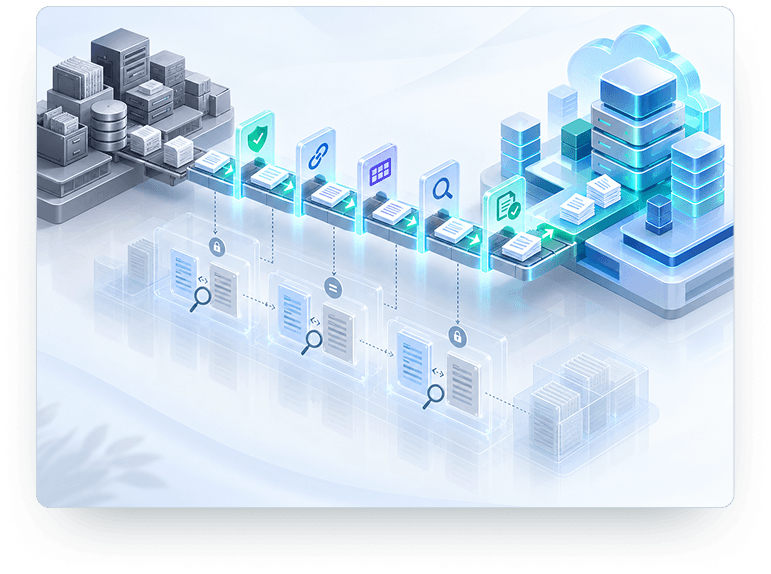
Financial operations governance, annotated
A governed payment-detail change traced through policy, authority and evidence — the same object the flow below follows.

Context changes the rules, the data treatment and the availability
Coverage carries its source and effective date. Where a source is stale or absent, the register says so rather than resolving to a default.

Prove the control operated — not merely that a policy existed
Six layers, each with its required content and the interface pattern that carries it.
Governance decision
Workflow history
Document lineage
Operational event
Evidence manifest
Integrity controls
Every control tile carries its claim status
Architecture requirement, stated implementation status, roadmap item or partner-supported — labelled per tile, never averaged into a posture score.
Zero-trust architecture
Identity-verified access with no implicit network trust.
Identity & segregation of duties
Role, attribute, entity and delegation controls with SoD evaluation.
Encryption in transit and at rest
Status is stated per deployment rather than as a universal claim.
Customer-managed key custody
Depends on deployment option and approved region.
Region-aware residency
Primary storage region does not imply all lifecycle stages stay in region.
Independent certification
The control framework exists. No SOC, ISO or PCI certification is claimed.
Sovereign deployment
Not currently available. Requirements can be discussed with an architect.
Tamper-evident evidence chains
Append-only records with cryptographic validation where implemented.
Third-party penetration testing
Conducted through approved partners; reports available under agreement.
Adopt without a big-bang replacement
Progressive replacement with migration integrity checks, and a Shadow Ledger that compares without executing.
ADOPTION SEQUENCE
Connect — versioned APIs and events against ZoikoSchema
Map — object and field mapping with correction authority held by the data owner
Shadow Ledger — proposed governed behaviour compared with current operation
Reconcile — counts, balances and relationships verified with variance dispositioned
Activate selected scope — on a named human decision, with rollback defined first
Progressively replace — scope by scope, never all at once
What AI may and may not do here
Stated as two explicit lists rather than a general reassurance. The boundary is the product feature.
AI MAY
- Classify and group exceptions for review
- Detect anomalies against configured expectations
- Forecast exposure from source data, labelled as a projection
- Suggest reconciliation matches for a human to confirm
- Summarize a decision basis with its sources cited
- Flag an obligation or control that appears to need attention
AI MAY NOT
- Approve, authorize or execute any financial action
- Post, adjust or reverse a ledger entry
- Change source truth or overwrite an authoritative record
- Determine accounting treatment or a tax position
- Mark a control, close dependency or obligation as satisfied
- Substitute for legal, tax, accounting or audit judgment
Where to go next
Banking and Insurance are separate destinations with their own claim boundaries. This page deliberately does not cover their subject matter.
Banking
Core banking, payments processing and prudential subject matter belong to that destination and are not claimed here.
Route pending approval
Insurance
Policy administration and claims processing belong to that destination and are not claimed here.
Route pending approval
All industries
Organization patterns and structural context across every sector.
Industry solutions
The ten critical operating challenges, each with its own proof contract.
Not published
No approved customer story exists for this industry. No anonymised composite or representative outcome is substituted.
No regulated legal, tax, accounting or audit advice is provided. No accounting treatment, tax position, prudential outcome or compliance certification is determined or guaranteed.
Bring the control you cannot currently evidence
A payment approval nobody can reconstruct. A close dependency that blocks every month for the same reason. A jurisdiction rule whose source nobody owns. We will trace one through the policy, authority and evidence model against your own entity and jurisdiction scope.
No capability availability, jurisdiction coverage, residency option, certification or regulated outcome is committed outside an approved commercial document.
Book enterprise demo
Every section of this page was readable without it.
Scope, certification, coverage and AI boundaries
Direct first sentences, then qualified detail. Every answer is present in the page source.
It governs financial operations — evaluating material actions against policy and delegated authority before they complete, and preserving the decision basis as evidence. Entity, jurisdiction and effective-date context are held at the point of action, and authoritative records remain in the systems that already hold them.