COO
Bring operating decisions, ownership and evidence into focus.
Explore a governed approach to coordinating work, clarifying responsibilities, handling exceptions and reviewing operational outcomes across functions. Available capabilities and integrations are confirmed during evaluation.

OPERATING CONTEXT
Explore the responsibilities behind the decision.

OPERATING PRIORITIES
Three questions to start the review.

What needs leadership attention?
Scope, signal and source context before interpreting a risk.

Who owns the handoff?
Accountability, dependencies and decision rights.

What confirms the outcome?
Expected result, verification and unresolved evidence.
SIX QUESTION-LED DISCLOSURES
A clearer operating model.
Scope → signal → owner → status → source → review. No invented health percentages.
Exceptions / recovery
No signal, partial data, delayed/stale source, unsupported connector or permission constraint.
Authority
Functional process owners, IT/data, Security and applicable policy owners validate real capability and permissions.
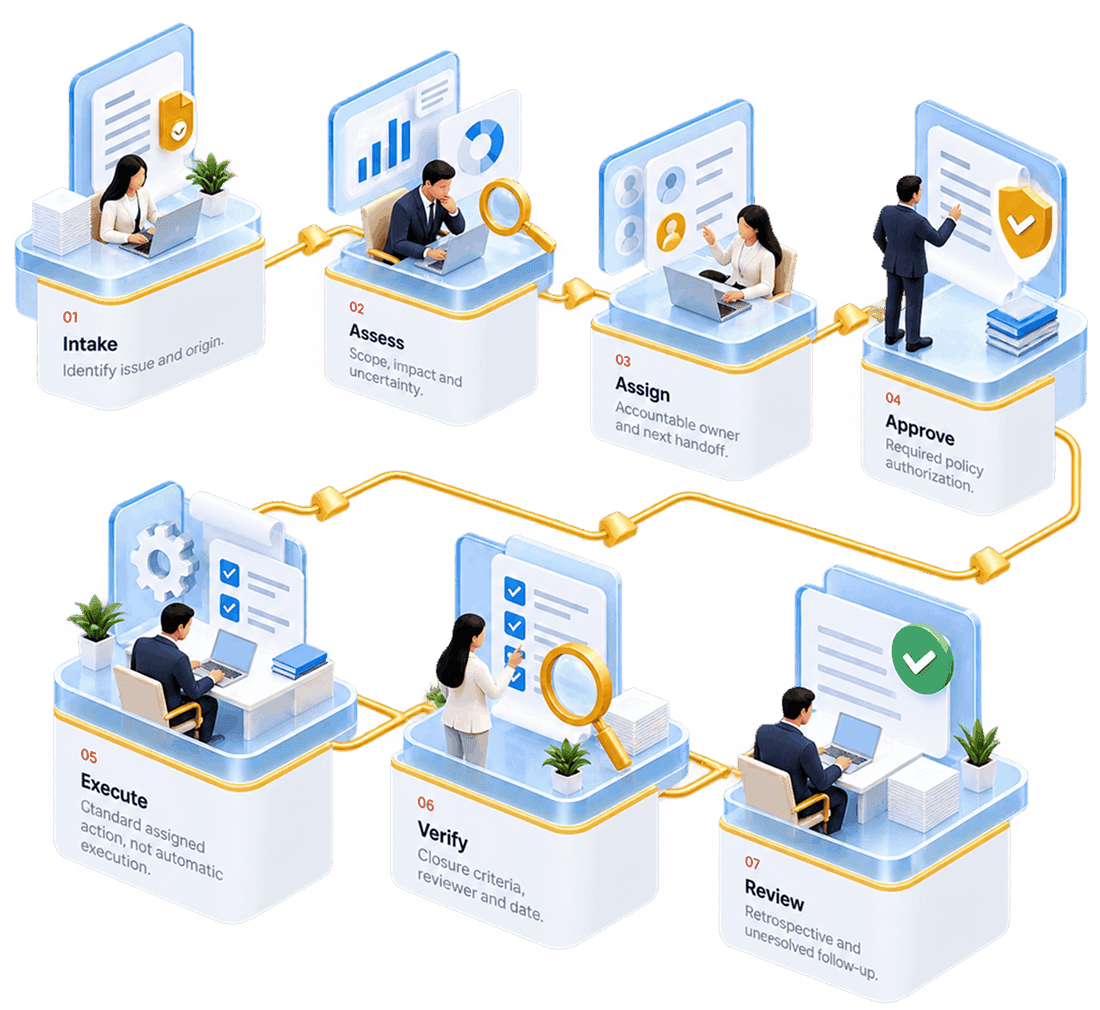
END-TO-END CONCEPT
From exception to reviewed outcome.
Intake
Identify issue and origin.
Assess
Scope, impact and uncertainty.
Assign
Accountable owner and next handoff.
Approve
Required policy/authorization.
Execute
Bounded assigned action, not automatic execution.
Verify
Closure criteria, reviewer and date.
Review
Retrospective and unresolved follow-up.
ROLE BOUNDARIES
Coordination does not erase authority.
COO
Operating decisions and cross-team accountability; no blanket HR/payroll access.
CIO
Systems and technical governance remain IT-owned.
CHRO
Sensitive employee and workforce policy remain HR-owned.
Controller / CFO
Finance segregation cannot be overridden by operations.
Tax / Compliance
Regulatory interpretation and filing scope remain specialized.
Audit / Board
Governed oversight, not public access to private workpapers.
DEFINING PROPERTIES
Shared principles.
Specialized responsibilities.
Canonical governed-operation properties remain owned by their approved destination; no competing taxonomy is invented here.

Clear answers before evaluation.
CONTEXT BEFORE CONVERSION
See how this applies to your own governance model.
Discuss the scope, responsibilities and evidence you need. This page illustrates a concept; it does not establish live product capability.
LOCAL BRIEFING PREVIEW
Start with one operating decision.
Approved briefing/provider and privacy routes were not supplied. This form sends/stores no information and books no meeting.